

Yes — and the fact that you’re asking probably means you’ve already tried the alternative.
Every CRM demo looks clean. Then you sit down to map your actual sales process onto it, and the friction starts. Your pipeline has a stage theirs doesn’t. You track a thing that doesn’t fit any field. The “deal” in their model isn’t quite the deal in your business. So you start bending — custom fields here, a workaround there, a consultant on retainer — and a year later you’re running your business inside someone else’s assumptions, paying every time you need them to flex.
The question isn’t really “can I get a CRM?” It’s “can I get one shaped to how we sell, without it becoming a forever project?” That has a good answer, but it helps to see why the usual two options disappoint first.
Why packaged CRM fights you
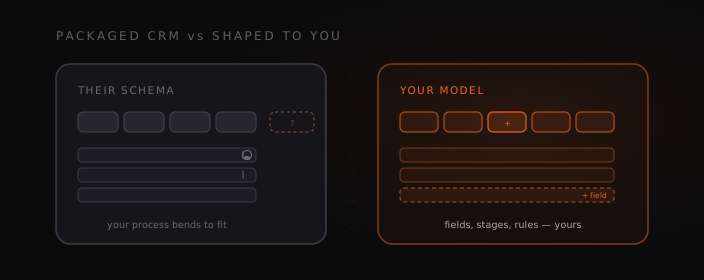
A packaged CRM is a set of decisions someone else made: these stages, these fields, this definition of a contact, a lead, an opportunity. When your business matches those decisions, it’s great. When it doesn’t — and growing businesses almost never do for long — every difference becomes a workaround, and every workaround becomes something you maintain.
The schema is the real lock-in. Not the price, not the contract. The shape of the data is fixed, and your process has to contort to fit it.
The two ways teams usually lose
Bend a rigid CRM. Bolt on custom fields, wire up some automation, hire someone who knows the platform. It works, sort of — but you’re still inside the vendor’s model. The next time your process changes, you’re back in the queue, paying for changes to software you don’t really control.
Build one from scratch. Hand it to developers and get exactly what you want — after months, and a budget, and the discovery that you now own a custom application that needs maintaining forever. The fit is perfect on launch day and decays from there.
Most teams ping-pong between these two. There’s a third path.
The third path: start from a foundation, then shape it
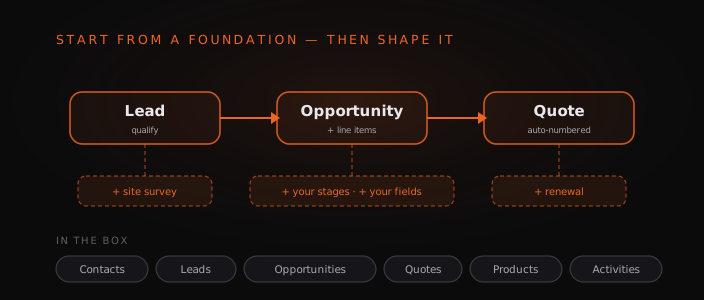
dForge ships a working CRM out of the box — contacts and the companies behind them, leads, opportunities with line items, quotes, a product catalog, and activities. That’s a real starting point: a sales motion you can use on day one.
But it’s a starting point, not a ceiling. Because the whole thing is defined by metadata rather than hard-coded, you reshape it to your business:
- Rename and reorder the pipeline stages so they match how you actually sell, not how a vendor assumed you do.
- Add the fields you track and drop the ones you don’t — your qualifiers, your industry-specific attributes, the numbers your team lives by.
- Add entirely new entities — a site survey, a renewal, an onboarding, whatever your process needs — and link them into the model.
- Wire the rules — automatic quote numbering, calculated fields, validation, lifecycle states.
The point isn’t a slick drag-and-drop toy. The point is that changing the model is configuration, not a code fork — so the next change is a change, not a rebuild. You don’t start from a blank page, and you don’t inherit a black box.
Here’s what that looks like in practice: the foundation gives you the pipeline and the core records, and you extend it outward — your stages, your fields, your own entities hung off the parts that already work.
And the CRM you shape is one you own
This is the part packaged CRM can’t offer at any price. The custom CRM you build on dForge is a standard PostgreSQL database — your contacts, your pipeline, your quotes, in real tables you can query, back up, and self-host. The model you shaped is yours, not a configuration trapped inside a vendor’s runtime.
That changes the calculus entirely. You’re not betting your customer data and sales history on a vendor staying exactly as it is forever. We wrote about precisely where that ownership line sits — and, honestly, where it doesn’t — in Only You Own Your Data.
Where the line is
Honesty matters here, because “custom CRM” means different things to different people.
dForge is for your internal sales team — the operational platform your sales motion runs on. It is not a customer-facing portal (dForge has no external end-user side), and it is not a marketing-automation suite out of the box: it won’t run drip email campaigns or score inbound leads from your website for you. What it gives you is the durable, owned core — accounts, pipeline, quotes, activities, history — shaped to exactly how your business sells, and built to outlive whoever set it up.
If what you need is a marketing engine or a public-facing product, that’s a different tool. If what you need is a CRM that finally matches your process and that you actually own, that’s the whole idea.
Frequently asked questions
Can I customize the sales pipeline and stages? Yes. The pipeline stages, the fields on each record, and the rules between them are all part of the model you shape — so you set them to match how your team actually sells, and change them later without a rebuild.
Do I need developers to build a custom CRM in dForge? You don’t start from scratch — the CRM foundation is there on day one. Shaping it is configuration of the metadata model rather than application engineering, so much of it doesn’t require a developer; deeper changes are still configuration, not a custom codebase you have to maintain.
Can I add my own fields and entities? Yes. Beyond adding fields to existing records, you can add entirely new entities — the objects specific to your business — and link them into the CRM, so the model covers your whole process, not just a generic sales pipeline.
Is my CRM data actually mine? Yes. Your CRM runs on a standard PostgreSQL database, one per tenant, that you can query directly, back up, and self-host. See Only You Own Your Data for exactly what that means.
Can dForge replace Salesforce or HubSpot? For the operational core — accounts, pipeline, opportunities, quotes, activities — shaped to your process and owned by you, yes. For marketing automation, inbound lead scoring, or customer-facing experiences, no; those are different tools. dForge is the internal operational core, not a marketing or external-facing platform.
How long until I have a working custom CRM? You can start using the CRM foundation immediately and shape it as you go, rather than waiting months for a from-scratch build to finish before anyone can log in.
If you’ve outgrown packaged CRM and you’re weighing a from-scratch build, there’s a path between the two: start from a real foundation, shape the model to your business, and own what you end up with. That’s what dForge is for — see how the whole platform is built.