Packaged CRMs are good software, and modern ones are highly configurable. You can add fields, rename pipeline stages, create custom objects, and wire up automations without writing code. So the friction a growing business eventually feels is easy to misdiagnose. It rarely comes from the tool being unable to do something. It comes from a quieter distinction that does not matter on day one and matters a great deal later: you can shape the tool within the boundaries the vendor sets, but you do not own the model underneath it.
For most companies that distinction never becomes a problem, and a configurable packaged tool serves them well for years. The companies that feel it are the ones whose operations are distinctive or change quickly, because they reach the edge of what configuration allows sooner and more often. What happens at that edge is the real story.
The ceiling on configuration
Configuration works beautifully right up to the point where it stops. You add the fields you need, adjust the stages, build a custom object or two, and the tool fits. Then a requirement arrives that the vendor’s model was not built to hold. It might be a limit on how many custom objects your plan allows, an automation the platform does not permit, a data structure that has to conform to the vendor’s rather than yours, or a capability reserved for a more expensive tier. The requirement does not disappear. It gets met with a workaround.
The workarounds are individually reasonable and collectively corrosive. A field gets repurposed for something it was never meant to hold. A part of the process moves into a spreadsheet beside the tool. A second product gets bolted on to cover what the first one could not. Each decision makes sense in the moment, and together they slowly rebuild the fragmentation the tool was supposed to remove. The single source of truth becomes one source among several again.
Underneath the workarounds sit the things you cannot change at all. The data lives in the vendor’s environment rather than yours. The pace at which new capability arrives is set by the vendor’s roadmap, not your needs. The pricing is tied to the vendor’s model, often to the number of seats, rather than to the value you actually get from it. None of this is a defect. It is simply what renting a model means. You are working inside a system someone else owns, and when your business and that system diverge, the business is usually the one asked to bend.
The usual responses, and what they share
A company that reaches this edge tends to do one of three things. It bends the process to fit the tool, which restores order at the cost of the practices that made it effective. It stacks on more tools to cover the gaps, which trades a single constraint for an integration problem. Or it pays its way up the tiers, which buys a little more room without changing the fundamental arrangement. Each of these accepts the same premise, that the model stays the vendor’s and the business adapts to it. That premise is the thing worth questioning.
Owning the model instead of renting it
The alternative is to own the model rather than configure someone else’s. With dForge, the entities, fields, and lifecycle your business runs on are defined by you, and you extend them yourself rather than waiting on a roadmap or running into a tier wall. This is not a blank slate that asks you to build everything from nothing. dForge ships working modules, including a Sales CRM, so you start from something real and shape it to your operation instead of shaping your operation to it. When you need something the standard model does not cover, you add it on the same platform rather than bolting another product alongside it, so the parts of the business stay on one model rather than scattering across several.
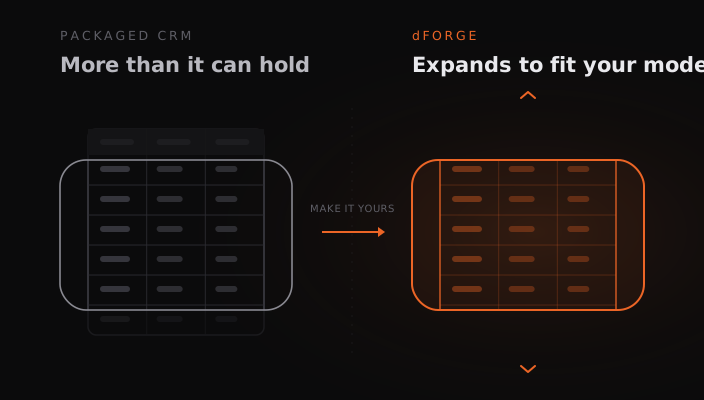
The ownership extends to the data. Every deployment is single-tenant, and you can self-host it, which means the records that run your business sit in a database you control rather than in a shared environment you cannot inspect. The model is yours to change, the data is yours to keep, and adjusting either is something you do rather than something you file a request for and wait on.
This is a real trade, not a free lunch. Owning a model means you are responsible for shaping it, and for many businesses a configurable packaged tool is the better choice precisely because they do not want that responsibility. The argument is not that ownership is always right. It is that for a business whose operations are genuinely its own, the difference between configuring a tool and owning a model is the difference between one you grow into and one you eventually grow out of.
Where the difference shows up
A configurable tool and an owned model feel identical at the start. Both let you adjust fields, name your stages, and shape the early version to your liking. The difference only appears at the edge, when the business needs something the vendor’s model was not designed to hold. At that moment a configurable tool asks the business to adapt, and an owned model adapts to the business.
Most companies never reach that edge, and for them the question is academic. If your operation is distinctive enough that you keep reaching it, that is exactly the situation dForge is built for. See how it works at dForge.